
What is GEO? The Definitive Guide to Generative Engine Optimization
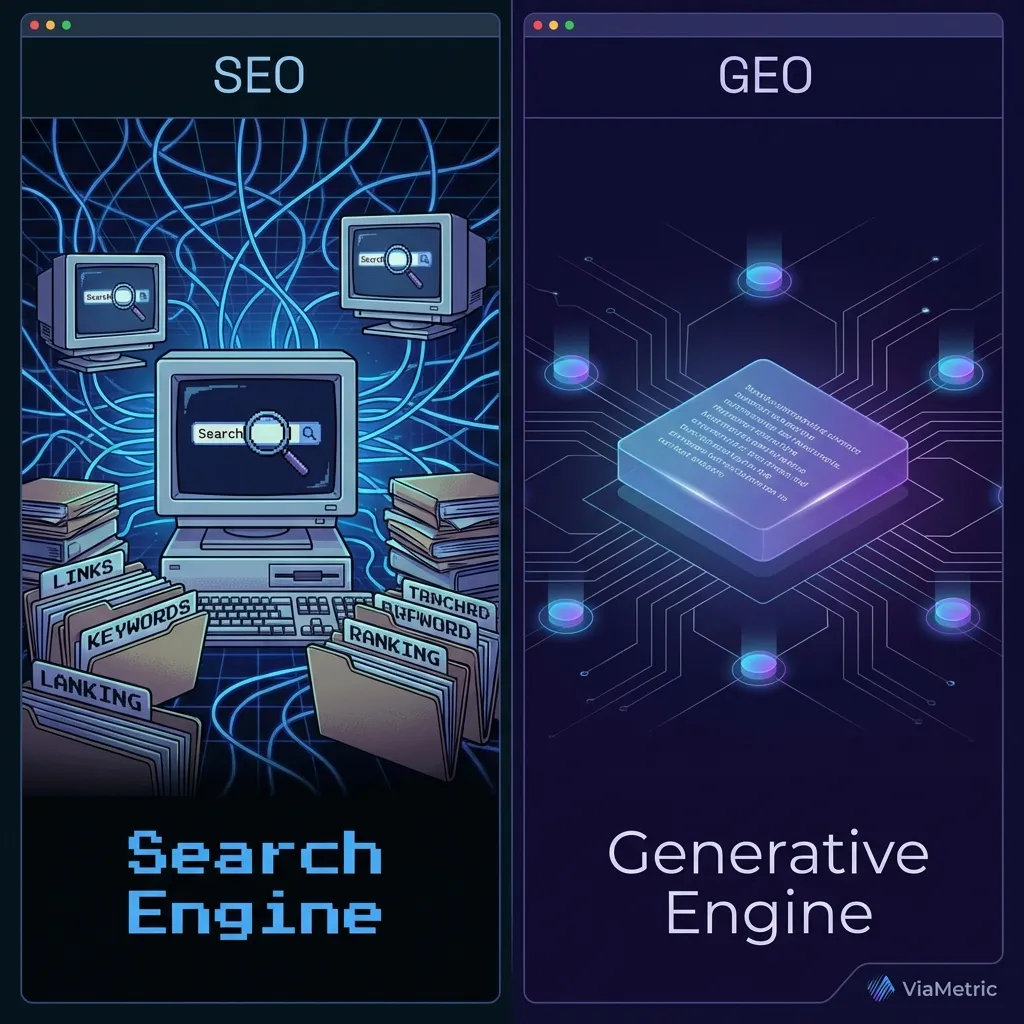
If you work in marketing, you have likely heard the term GEO thrown around recently. But what does it actually mean for your day-to-day strategy?
This is the definitive definition and guide to Generative Engine Optimization (GEO).
Definition
Generative Engine Optimization (GEO) is the multi-disciplinary practice of creating content that is specifically designed to be ingested, understood, and cited by Large Language Models (LLMs) and Generative Answer Engines.
In simple terms: SEO is about convincing a robot to rank you #1 in a list. GEO is about convincing a robot that you are the factual source of truth for an answer.
The Evolution: From Blue Links to Answers
To understand GEO, we must look at the timeline of search behavior:
- 1998 - 2023 (The SEO Era): Users search "best crm". Google returns 10 links. User clicks 3 links, reads them, and synthesizes the answer themselves.
- 2023 - Present (The GEO Era): User asks ChatGPT "What is the best CRM for small teams?". The AI reads 10 links for the user, synthesizes the answer, and presents a single result with citations.
The user never clicks the links. They only read the citation.
For a deeper comparison of the metrics, read our detailed guide: SEO vs GEO: The New Paradigm.
The 3 Pillars of GEO
According to research from Princeton, Georgia Tech, and industry case studies, LLMs favor content that exhibits three specific traits:
1. Citation Authority
AI models are "hallucination-averse." They prioritize sources that are corroborated by other trusted entities. If your brand is mentioned by .edu sites, Wikipedia, or major news outlets, the AI assigns a higher probability of truth to your content.
2. Information Density
LLMs have a limited "context window." They prefer content that conveys maximum information in minimum tokens. Fluff, adjectives, and long intros—staples of traditional SEO—are penalized in GEO. Facts, statistics, and direct definitions are rewarded.
3. Structured Data
AI bots (like GPTBot) are widely considered "lazy." If they have to guess what your page is about, they often ignore it. Using JSON-LD Schema (e.g., FAQPage, Article, SoftwareApplication) explicitly tells the bot how to categorize your content.
Learn how to measure your technical readiness: Understanding your GEO Score.
The Key Engines
When we talk about GEO, we are primarily optimizing for these platforms:
Perplexity (The Referral Engine)
- Type: Answer Engine with heavy citation focus.
- Goal: High-intent traffic. User often clicks citations to verify.
- Ranking Factor: Freshness and Domain Authority.
ChatGPT (The Knowledge Engine)
- Type: Reasoning Engine (LLM).
- Goal: Brand Awareness (Share of Voice). Users rarely click out.
- Ranking Factor: Brand Entity associations and Information Gain.
Google Gemini (The Hybrid)
- Type: Hybrid Search/AI.
- Goal: Traffic protection.
- Ranking Factor: Traditional SEO signals + AI Overview inclusion.
Conclusion
GEO is not "replacing" SEO tomorrow, but it is effectively replacing the "Top of Funnel." Informational queries ("What is X?", "How to Y") are moving to AI. Transactional queries ("Buy X") remain in Search.
To survive in 2026, you need a strategy for both.
Curious about your current performance? Test your site with our Free AI Visibility Checker or monitor your real-time mentions on ViaMetric.
AI Visibility Checker
Check if ChatGPT, Perplexity, and Gemini can access your content.

Davide Agostini
Android Mobile Engineer and Founder of ViaMetric. Davide specializes in technical SEO and the emerging field of Generative Engine Optimization (GEO), helping founders navigate the shift from links to AI citations.
Frequently Asked Questions
- What does GEO stand for?
- GEO stands for Generative Engine Optimization. It is the practice of optimizing web content to appear in the synthesized answers of AI search engines like ChatGPT, Perplexity, and Gemini.
- How is GEO different from SEO?
- SEO optimizes for clicks from a list of blue links. GEO optimizes for citations in a single AI-generated answer. SEO focuses on keywords; GEO focuses on information density and authority.
- What are the main GEO engines?
- The primary engines are ChatGPT (OpenAI), Perplexity (Perplexity AI), Gemini (Google), and Bing Chat (Microsoft).