
Subjectivity vs. Objectivity: Why Facts Rank Better in AI
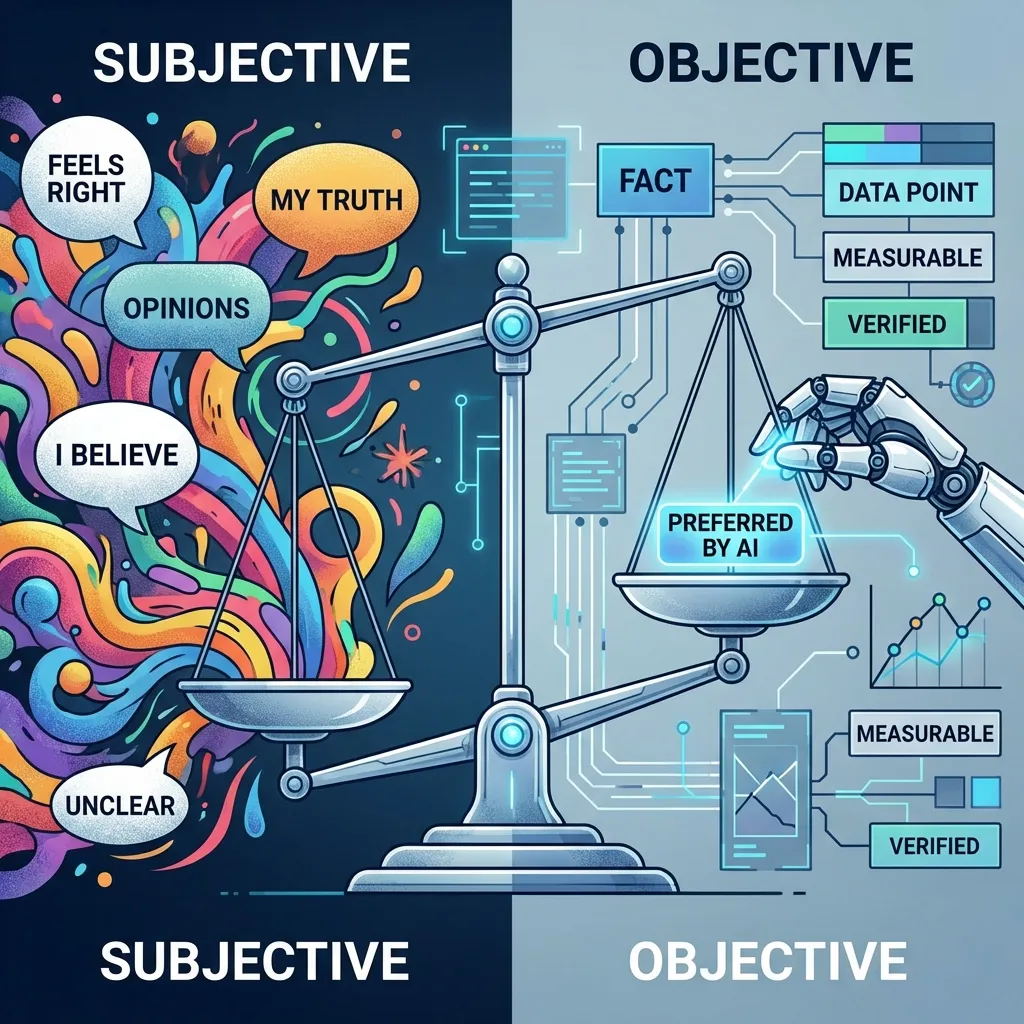
Executive Summary: Generative AI models like ChatGPT and Gemini prioritize factual accuracy to reduce liability and hallucinations. This article explains why content with a Low Subjectivity Score is more likely to be cited as a source of truth, and provides actionable steps to strip bias from your copy.
The Liability of Opinion
For a search engine like Google, an opinionated blog post is content. For an AI model, an opinionated blog post is a risk.
If an AI cites a review saying "Brand X is a scam," it opens the model creator to defamation issues. If it cites a review saying "Brand X lacks feature Y," it is stating a verifiable fact.
Therefore, the algorithms are tuned to detect and deprioritize High Subjectivity content when looking for definitive answers.
Understanding the Subjectivity Score
In Natural Language Processing (NLP), text is often scored on a Subjectivity scale:
- 0.0 (Objective): "SpaceX launched the Starship rocket on Thursday."
- 0.5 (Mixed): "SpaceX's exciting launch happened on Thursday."
- 1.0 (Subjective): "The incredible Starship launch was a miracle of engineering."
For Navigational and Informational queries ("What is X?", "How does Y work?"), the AI seeks content closest to 0.0.
How to Write for Low Subjectivity
1. Verification over Adulation
Replace hype words with data points.
- Bad: "Our software is the fastest on the market."
- Good: "Our software processes requests in 200ms, compared to the industry average of 500ms."
The second sentence is verifiable. The first is a claim. AI models struggle to verify claims, so they often discard them.
2. The Wikipedia Test
Wikipedia is the most-trained-on dataset in history. Its style guide strictly forbids "peacock terms" (legendary, best, amazing).
To rank in AI, mimic Wikipedia's tone. Be comprehensive, neutral, and dense with entities.
3. Separate Fact from Analysis
If you must give an opinion, clearly label it.
- "The battery lasts 12 hours." (Fact)
- "In our experience, this is sufficient for a full work day." (Analysis)
Measuring Your Content
Before hitting publish, run your content through a Subjectivity Analyzer. If you are consistently hitting >50% subjectivity, you are writing a persuasive essay, not a reference document.
In the age of GEO, be the reference document.
Is your content too opinionated for AI? Run our AI Visibility Checker and review how your brand appears in AI answers.

Davide Agostini
Android Mobile Engineer and Founder of ViaMetric. Davide specializes in technical SEO and the emerging field of Generative Engine Optimization (GEO), helping founders navigate the shift from links to AI citations.
Frequently Asked Questions
- What is a Subjectivity Score?
- It is a measure (0-100%) of how much personal opinion is in a text. 0% is pure fact; 100% is pure opinion. AI prefers lower scores for definitions and answers.
- Should I remove all adjectives?
- No. Descriptive adjectives (e.g., 'solar-powered') are factual. Evaluative adjectives (e.g., 'amazing') are subjective. Reduce the latter.
- How does this affect voice search?
- Voice assistants read single answers. They are programmed to select the most 'neutral' and 'verified' answer to avoid bias liability.