
SEO is Dead. Long Live GEO: The AI Search Revolution
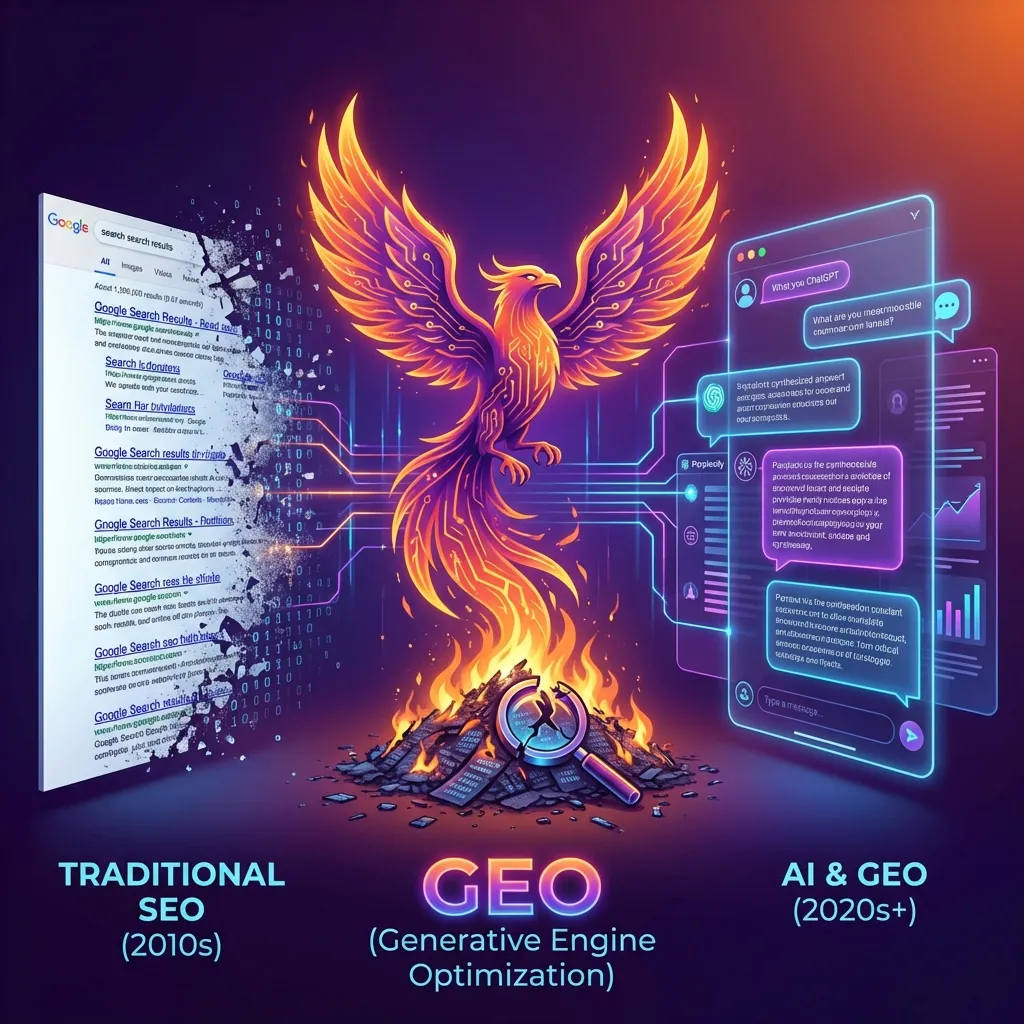
Google isn't the only search engine anymore. ChatGPT, Perplexity, and Gemini are answering questions directly—and they're not using your meta descriptions to do it. If you're still optimizing solely for clicks on blue links, you're playing a game that's shifting under your feet.
Welcome to the era of GEO (Generative Engine Optimization).
The Shift: Traditional SEO vs. AI Search
Traditional SEO thrived on Google's "10 blue links" model. The goal was simple using keywords and backlinks: rank high, get the click, and monetize the traffic on your site. You crafted meta titles, optimized for specific keywords, and built authority through external links.
AI Search flips the script entirely.
Tools like ChatGPT and Perplexity deliver "one synthesized answer" pulled from multiple sources across the web. The user often gets the answer without clicking anywhere. The new metric isn't the click—it's the Citation. Your goal is to be the source that the AI quotes to build its answer.
Key Stat: 40% of Gen Z now prefers TikTok or AI chatbots for search over Google, according to recent data. With AI handling a rapidly growing share of queries, traditional tactics like keyword stuffing are losing power to Content Density and Authority.
What is GEO (Generative Engine Optimization)?
Generative Engine Optimization (GEO), sometimes called AIO (Artificial Intelligence Optimization), is the art of making your content AI-readable and citation-worthy. Unlike SEO's focus on human browsing patterns, GEO optimizes for how Large Language Models (LLMs) scrape, vectorize, and retrieve your page.
A recent study by researchers at Princeton and Georgia Tech analyzed over 10,000 queries to understand what makes LLMs cite one source over another. The results define the new ranking factors:
- Citation Probability: How likely an AI deems your content authoritative enough to quote.
- Information Density: High-value facts per sentence. Fluff is ignored; data is cherished.
- Semantic Structure: Using logical hierarchy (H2s, H3s, Lists) that helps machines parse relationships between facts.
How to Rank in AI Search Engines? (3 Proven Strategies)
AI engines cut through the noise to find the signal. Here are three actionable strategies to boost your GEO visibility:
1. Optimize for "Answer Engines" (Direct Answers)
LLMs are prediction machines. They predict the best next token to satisfy a prompt. To be cited, your content should directly answer questions in a format that is easy to ingest.
- Strategy: Include direct, definitional sentences. "Usage-Based Pricing is a monetization model where..."
- Why it works: It lowers the "ingestion cost" for the AI, making your definition the easiest one to grab.
2. Boost Authority with Statistics
AI models have been trained to value empirical evidence. The Princeton study showed that adding statistical evidence and citations to reputable sources (.edu, .gov, or trusted industry reports) can boost AI visibility by 30-40%.
- Strategy: Don't just make claims. Back them with data. "Our tests show X improves Y by 20%."
3. Implement Structured Data (Schema)
While LLMs are smart, they crave structure. Embedding JSON-LD schema markup helps clarify exactly what your page is about.
- Strategy: Use
Article,FAQPage, andProductschemas. This gives the AI definitive context, turning vague text into structured knowledge.
Measuring Success in the AI Era
In traditional SEO, you track rankings and clicks. In GEO, you must track Mentions and Share of Voice.
If ChatGPT answers a user's question about "Best SEO Tools" and lists your product, that is a win—even if they don't click. That mention builds brand authority and leads to high-intent traffic later ("Navigational Search").
How to track this? You can't Google yourself in ChatGPT. You need tools that simulate AI queries.
Check Your AI Visibility
Wondering if Perplexity or Gemini knows you exist?
I built ViaMetric to solve this. It's an AI-first web analytics platform designed for comprehensive AI traffic tracking and AI search analytics.
- LLM Simulator: Perform instant AI citation tracking and test if your URL gets cited for key queries.
- Brand Mention Monitor: Track your AI brand mentions and visibility across all major AI models over time.
Don't wait for traffic to drop. Start optimizing for the engines of tomorrow, today.
Ready to audit your site? Try the free LLM Simulator →

Davide Agostini
Android Mobile Engineer and Founder of ViaMetric. Davide specializes in technical SEO and the emerging field of Generative Engine Optimization (GEO), helping founders navigate the shift from links to AI citations.
Frequently Asked Questions
- What is GEO (Generative Engine Optimization)?
- Generative Engine Optimization (GEO), also known as AIO, is the practice of optimizing content for AI-driven search engines like ChatGPT and Perplexity. Unlike traditional SEO, GEO focuses on content density and authority to get cited in AI-generated answers.
- How is AI Search different from Traditional SEO?
- Traditional SEO targets Google's 'blue links' model using keywords and backlinks. AI Search utilizes tools like ChatGPT to synthesize direct answers. The goal shifts from getting clicks to earning citations in these synthesized answers.
- How do I rank in AI Search Engines?
- To rank in AI search engines, focus on three strategies: 1) Optimize for direct answers with clear definitions, 2) Boost authority using valid statistics and verifiable citations, and 3) Implement structured data like JSON-LD schema.
- What metrics matter in the AI Search era?
- In the AI era, unlike traditional SEO, the key metrics to track are 'Mentions' and 'Share of Voice'—measuring how often your brand is cited in AI-generated responses.