
How to Steal Competitors' AI Citations: A Guide to Competitive Gap Analysis
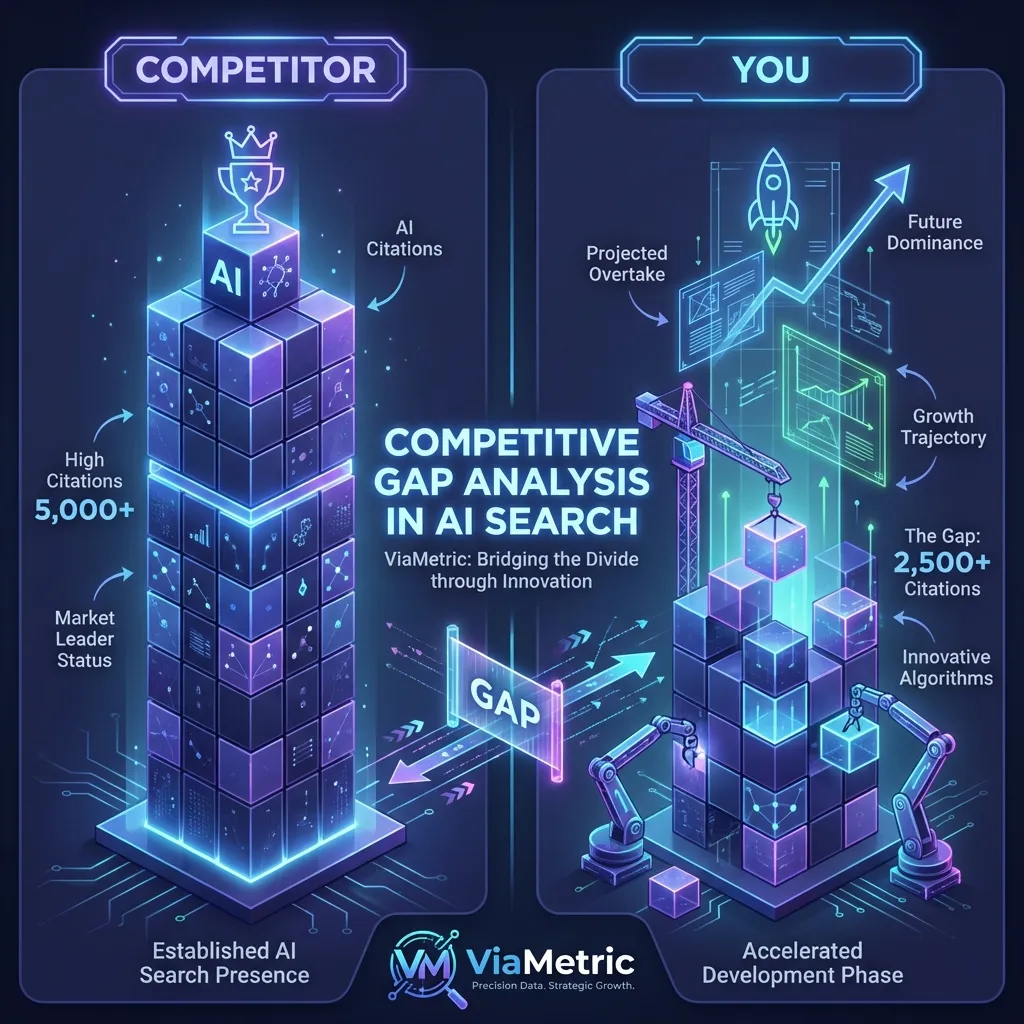
You own the keyword on Google. You have the #1 snippet. You have the backlinks.
But when a user asks ChatGPT: "What is the best tool for X?"
It recommends your competitor.
This is the AI Competitive Gap. And in 2026, it's the most dangerous leak in your funnel.
The "Silent" Market Share Loss
In Traditional SEO, if you lose a ranking, you see it in your traffic stats immediately. In AI Search, the loss is silent.
Your competitor isn't stealing your clicks; they are stealing your brand authority. When Perplexity cites them as the "industry standard" for an answer, thousands of users accept that as truth without ever visiting either website.
Step 1: Identify "Citation Monopolies"
The first step is to find where you are invisible.
A Citation Monopoly is a query where the AI only offers one clear recommendation.
- User: "Best CRM for small business?"
- AI: "HubSpot is widely considered..."
If you are a CRM, you don't just need to "rank"—you need to break the monopoly.
How to find gaps:
- List your top 10 money keywords.
- Ask ChatGPT/Perplexity/Gemini: "Who are the top providers for [keyword]?"
- Note who is mentioned. If it's not you, you have a gap.
Faster way: Use the ViaMetric Competitive Gap Grid to automatically track your Share of Voice vs. up to 10 competitors.
Step 2: The "Why Them?" Audit
Why did the AI choose them? LLMs aren't random; they are probabilistic. They cite the source that best statistically satisfies the prompt.
Analyze your competitor's content for:
- Definitions: Do they have a clear, concise definition of the term? "X is Y."
- Data: Do they cite specific numbers? "95% of users..."
- Structure: Is their content easy to parse (lists, tables)?
The Rule of Displacement: To replace a competitor, your answer must be easier for the AI to ingest and denser with information.
Step 3: The "Draft & Displacement" Strategy
Once you find the gap, fill it.
Don't just add keywords. Do rewrite your core content to be "Answer Engine Optimized."
The Displacement Formula:
- Direct Answer: Start sections with a 40-word definition.
- Proof: Add a proprietary statistic or quote.
- Structure: Use a Markdown table comparing you vs. others (AI models love tables).
Closing the Gap
Competitive Gap Analysis isn't a one-time task. It's an arms race.
Every week, check your Share of Voice.
- Did you appear in the "Top 3" list?
- Did the sentiment shift from Neutral to Positive?
Your competitors are already optimizing for AI. If you aren't fighting for these citations, you aren't just losing traffic—you're losing the future definition of your category.
Ready to close the gap? Check your Competitive Gap Score now.

Davide Agostini
Android Mobile Engineer and Founder of ViaMetric. Davide specializes in technical SEO and the emerging field of Generative Engine Optimization (GEO), helping founders navigate the shift from links to AI citations.
Frequently Asked Questions
- What is Competitive Gap Analysis for AI?
- It's the process of identifying queries where AI models (ChatGPT, Perplexity) cite your competitors but ignore your brand. Fixing these gaps increases your Share of Voice.
- How do I steal an AI citation?
- You can't 'steal' in the traditional sense, but you can win the citation by identifying the specific data or definition the AI is pulling from your competitor, and publishing a denser, more authoritative version on your site.
- Why does my competitor rank higher in AI?
- AI models favor content with high information density, clear semantic structure, and strong entity associations. Your competitor likely answers the specific user intent more directly than you do.