
Entities vs. Keywords: The Strategy Shift for 2026
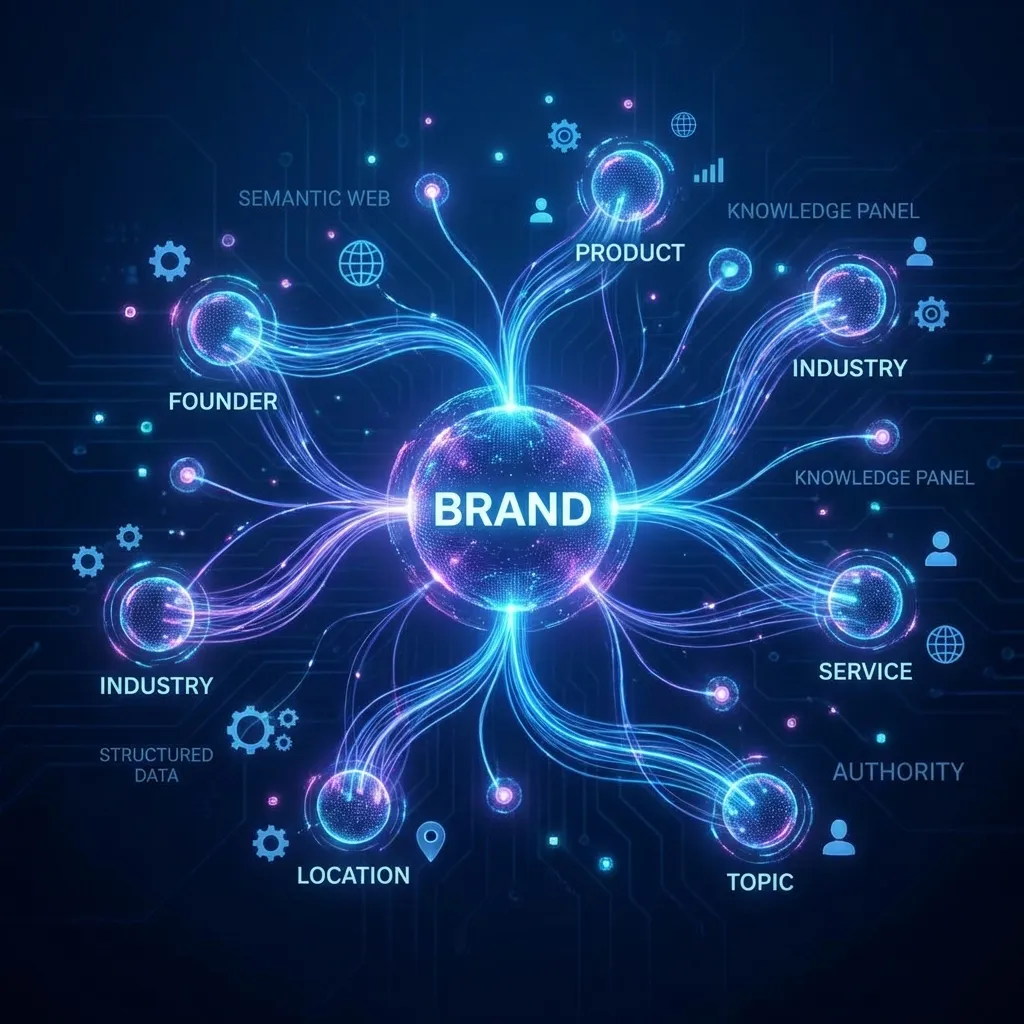
Executive Summary: The internet is moving from a library of documents (indexed by keywords) to a database of knowledge (connected by entities). This article explains the technical shift to "Things, not Strings" and how to future-proof your SaaS by establishing Entity Authority.
The Limitation of Keywords
In 2015, if you wanted to rank for "best email tool," you put those words in your H1. In 2026, AI understands that "Outlook," "Gmail," and "Superhuman" are types of email tools, even if the page doesn't spam the phrase "email tool."
This is the Entity Layer.
A Large Language Model (LLM) maps the world as a graph.
- Node A: Salesforce (Entity: Organization)
- Node B: CRM (Entity: Concept)
- Edge: Salesforce IS_A CRM.
If your brand is just a collection of keywords without a defined Entity node, the AI cannot confidently recommend it.
Establishing Your Entity
To become a "Thing" in the eyes of the AI, you must define yourself.
1. Consistent N.A.P. (Name, Address, Purpose)
Ensure your brand name, description, and core offering are identical across the web.
- Twitter: "AI Analytics Platform"
- LinkedIn: "AI Analytics Platform"
- Homepage: "AI Analytics Platform"
If you vary this (e.g., "Web Stats Tool" on Twitter), you dilute the entity association.
2. The "SameAs" Protocol
Use Organization Schema markup to link your homepage to your satellite properties.
"sameAs": [
  "https://twitter.com/yourbrand",
  "https://linkedin.com/company/yourbrand",
  "https://crunchbase.com/organization/yourbrand"
]
This tells the bot: "All these profiles belong to the same Entity."
3. Associate with Authority
Validating your entity requires association with other trusted entities.
- Guest appearances: Being cited by a high-authority entity (like HubSpot or a major news outlet) passes "Trust Flow."
- Integrations: Listing your integrations (e.g., "Works with Slack") creates a semantic edge between your unknown node and a known node (Slack).
Conclusion
Stop asking "What keywords should I use?" and start asking "What concepts am I related to?" By building a robust, interconnected Entity, you ensure that when an AI traverses the web of knowledge, all roads lead to your brand.
Is your entity defined? Check your technical schema status with our Structured Data Checker.

Davide Agostini
Android Mobile Engineer and Founder of ViaMetric. Davide specializes in technical SEO and the emerging field of Generative Engine Optimization (GEO), helping founders navigate the shift from links to AI citations.
Frequently Asked Questions
- What is an Entity?
- An entity is a distinct, independent thing (like a Person, Place, or Brand) that a search engine understands as a concept, not just a word.
- Are keywords dead?
- They are not dead, but they are downgraded. An AI looks for the relationship between entities (e.g., 'Davide' [Person] IS FOUNDER OF [Organization]) rather than just matching words.
- How do I build entity authority?
- Connect your brand to other known entities using Schema, backlinks from authoritative sites, and consistent citations in industry databases (Crunchbase, Wikipedia).